


As you read this, I’m somewhere with no signal, deep in the Dolomites, exactly where I want to be. Going off the grid meant, for the first time in the history of the Weekend Briefing, handing someone the keys, and there was only one person I wanted to give them to.
Blair Miller is one of my dearest friends and one of the sharpest thinkers I know. For the past year she’s been building something called The Humanist Renaissance, an argument that AI isn’t here to replace us but to return us to the parts of being human we let go slack: attention, taste, judgment, presence, the warmth of a real hand. I started reading her and couldn’t stop.
I asked Blair to take this issue because she’s chasing the most important question of the decade. When machines master the things we built our whole economy around, what part of being human do we refuse to give up? I can’t think of anyone better to sit with that for a week.
If what follows resonates, subscribe to The Humanist Renaissance and tell her I sent you.
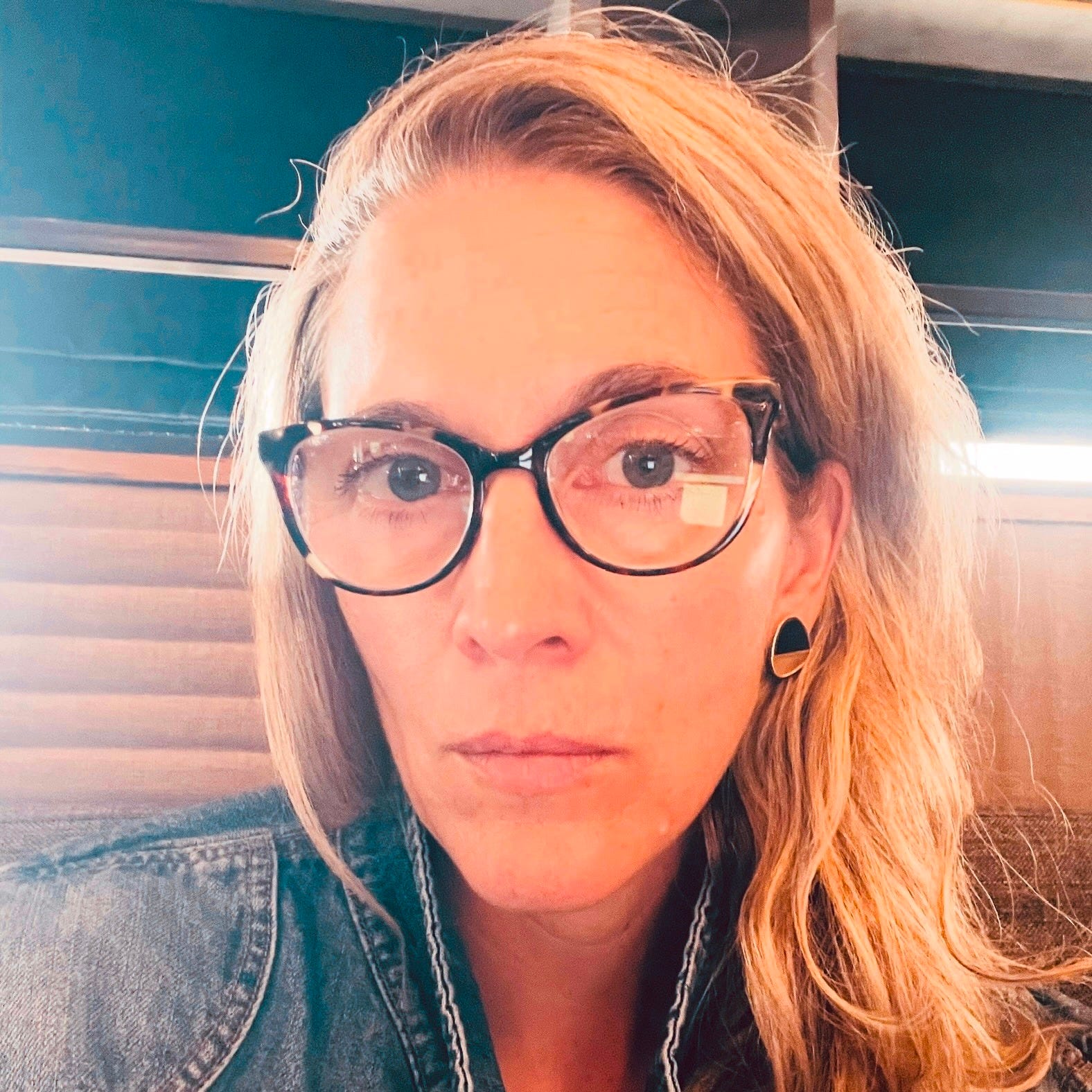
Guest Editor: Blair Miller, human.
Welcome to the weekend.
Kyle’s handed me the keys this week, so I want to use them on the idea that’s consumed me for the last year: the humanist renaissance.
For the last hundred years, we built a system that rewarded one kind of intelligence above all others — the kind that analyzes, abstracts, credentials, and performs certainty. The kind you can put on a résumé. AI is making this knowledge obsolete. What replaces it will be built from the kinds of knowing that system told us to deprioritize: the embodied, the relational, the felt. Attention, empathy, taste, judgment, presence, the warmth of a real human hand. These are the new scarce resource, on every continent. We’re not going to find our way through this transition by becoming more efficient. We’re going to find ourselves by becoming, deliberately, more human.
Meghan O’Gieblyn put it best in God, Human, Animal, Machine: meaning is an implicitly human category that cannot be reduced to quantification.
Prime Numbers
47 — The average length of time a person now spends on a screen before switching to another, according to two decades of research by UC Irvine informatics professor Gloria Mark. In 2004, that figure was 2.5 minutes. By 2012, it had dropped to 75 seconds. We are not who we were.
700 — Copies of Slow Ventures’ new modern etiquette handbook for tech founders sold in its first month. The VC firm now runs oversubscribed in-person classes teaching aspiring Zuckerbergs how to read a room, pair wine, and shake hands. Founding partner Sam Lessin’s diagnosis: AI has made coding “super commoditized,” so founders must now lean on the one quality AI can’t emulate — humanity. When the venture capitalists start selling etiquette schools, the humanist renaissance has officially gone mainstream.
159,000,000 — Fans who attended a Live Nation show in 2025, across 55,000 events worldwide. International markets surpassed the U.S. in attendance for the first time. People are flying across continents to share a room with other humans, doing something that cannot be streamed.
A Time We Never Knew
An incredibly beautiful piece of writing on this subject was written by a 26-year-old. Freya India, a British staff writer at Jonathan Haidt’s After Babel, grieves a life she barely lived: the anticipation of going to the movies, hitting a swing-ball for hours, sitting through a film without checking her phone. Her generation, she argues, has been turned from people into products. Her prescription: you just must be human. After Babel (7 min)
Welcome to Aesthetic Intelligence
Pauline Brown ran LVMH North America — the world’s largest luxury house, headquartered in Paris — and taught at Harvard Business School. In this founding post for her Substack, she lays out the whole frame in one read. Her diagnosis: thanks to AI, the barriers to analysis and production have collapsed. What is now scarce is judgment — the ability to select, edit, refine, and reject. The ability to distinguish between what is loud and what is lasting. To recognize the difference between what’s trending and what’s true. As she puts it: when everything is so easily and instantly available, nothing feels magical. Nothing is all that desirable. Her insistence — and this is what makes the piece a manifesto rather than a lament — is that aesthetic intelligence is not a mysterious gift or a class marker. It’s a muscle. And like any muscle, it must be exercised. In a world where everyone has the same tools, the only durable advantage left is the one we must build inside ourselves. Aesthetic Intelligence (8 min)
An Honest Conversation on AI and Humanity
The most-read public intellectual on the planet, in front of the most powerful audience on the planet, naming the humanist renaissance without naming it. At Davos in January, Israeli historian Yuval Noah Harari (Sapiens, Homo Deus, Nexus — 50 million books in 65 languages) delivered a keynote that frames what’s happening as nothing less than an identity crisis. For 2,000 years we defined ourselves as the thinking animal — I think, therefore I am. AI is now going to be better than us at thinking, if thinking means putting words in order. And, Harari notes, almost everything that organizes human civilization is made of words: laws, contracts, religions, money. So, what happens to our identity when machines master the substance of it? His answer is not nostalgic. It is a call to invest, deliberately, in the parts of us AI cannot reach. My mind is my most important tool. And nobody can invest in it for me. Full transcript via Singju Post (40 min read / video on YouTube)
A Time to Gather
Bruce Feiler — author of seven New York Times bestsellers and three TED Talks with five million views — has spent the last few years on a 50,000-mile road trip across sixteen countries on six continents asking what humans do when the old rituals fall apart. His new book, published this week, lays out the answer. The diagnosis is stark: it took us ten thousand years to establish cultural norms around how we mark collective life transitions. It took us fifty years to dismantle them. Birth rituals and coming-of-age rituals have plummeted. Fewer than half of Americans are married. Only one in three is buried. The book is part travelogue (from the Vatican to Bali to Las Vegas to Ireland), part blueprint — documenting the astonishing rise of new rituals people are inventing to replace the ones we lost. If the humanist renaissance is going to be real, it will be built out of exactly this kind of work: the deliberate, embodied reweaving of the social fabric AI cannot make. Penguin Press (book, ~9 hours)
First Jobs Matter More Than We Think
Wendy Kopp opens with Jack Waxman, a Cornell senior choosing between a coveted job in Chuck Schumer’s office and two years teaching at a school in East Harlem. A Teach for America alumna working in government had told him what she saw around her: people making policy decisions from “bubbles of power and prestige,” far removed from the communities affected. Jack chose the classroom. Kopp’s argument, drawn from 37 years of running Teach for America and the global Teach for All network across 60+ countries, is that first jobs are not warm-ups — they are the foundation of the leaders we become. Proximity to problems matters. And in a moment when AI is hollowing out the traditional knowledge-work apprenticeship, the formative experience may be the one no model can simulate: standing in front of 30 kids and figuring out how to teach them (something I can attest to as I did it when I was 20 in Ulsan, South Korea). If we want a generation capable of solving society’s hardest problems, we must send our most promising young people toward them, not away. The Atlantic (10 min)
A Defense of a Liberal Arts Education in the Age of A.I.
Ross Douthat (NYT) sits down with Jennifer Frey, a philosophy professor and the former dean of an honors college built on great books and the classical liberal arts. They wrestle with the question hovering behind every piece in this briefing: if the credential-and-output system of education is being eaten by AI, what comes next? Frey’s answer is bracing: the humanities are not a luxury, and never were. They are fundamental to human formation — the practice of becoming someone capable of judgment, virtue, and meaning. She knows what she’s talking about, because she watched her own program get gutted. The most surprising turn in the conversation: both Douthat and Frey think the age of AI might actually be the moment the liberal arts come back, precisely because everything else has become commoditized. Pairs perfectly with Wendy Kopp above — Kopp is about first jobs, Frey is about first educations — and together they answer the question of how we form humans capable of inheriting the world AI is making. Interesting Times — NYT podcast (1h 3min)
Pixar Already Showed Us
In 2008, before the iPhone was even a year old, Pixar released a film about a future where humans live aboard a corporate cruise ship called the Axiom. They float on hoverchairs. They never make eye contact. Each one has a screen positioned directly in front of their face, fed by an algorithm that tells them what to wear, what to eat, what to think. They have grown so dependent on automation that they have literally forgotten how to walk. The film is WALL-E, and it remains the most prescient piece of mainstream entertainment ever made about where screen-mediated, AI-managed life leads if we do not push back against it. The redemption arc is the part worth remembering. The humans on the Axiom recover their humanity in a single, quiet moment: two passengers’ screens malfunction, and for the first time, they see each other. They reach out. They touch. The whole movie turns on that one human gesture. Eighteen years on, the question WALL-E asked is no longer hypothetical: when the machines are this good at everything, what part of being human do we refuse to give up? WALL-E (Pixar, 98 min — worth rewatching)
When the Answer Is Generated in a Flash
Baratunde Thurston — Emmy-nominated storyteller, formerly of The Onion and The Daily Show — gave a keynote at the Richmond Forum that is the single best articulation of his thesis in one place. The premise: I wonder if our obsession with intelligence of an artificial nature has us wandering too far from our essential human nature. His best line, riffing on the Apollo astronauts who went to the moon and discovered Earth: when the answer to every question can be generated in a flash, then it’s time for us to question just what we want to ask. And the line I keep returning to: Just because something is faster doesn’t make it better. Some things in life we may want to slow down — time with people we care about, an enjoyable meal. The things that have the most meaning for us shouldn’t be made efficient. He also hosts the Life With Machines podcast, whose AI co-producer is named, no joke, BLAIR — a coincidence I’m still processing. Richmond Forum (45 min)
Keep the Conversation Going
If this resonates, I write about the humanist renaissance — the cultural shift, the institutions we’ll need to build, and the people already building them. Subscribe at humanistrenaissance.substack.com — and please write me back. I read everything.
— Blair
Weekend Wisdom
We went to explore the moon, and in the end, we discovered Earth. — William Anders, Apollo 8 astronaut
Loved this round up, especially the Gen Z take on nostalgia for a time we never experienced. So beautifully written
WALL-E—yes! I refer to it at least once a week.