

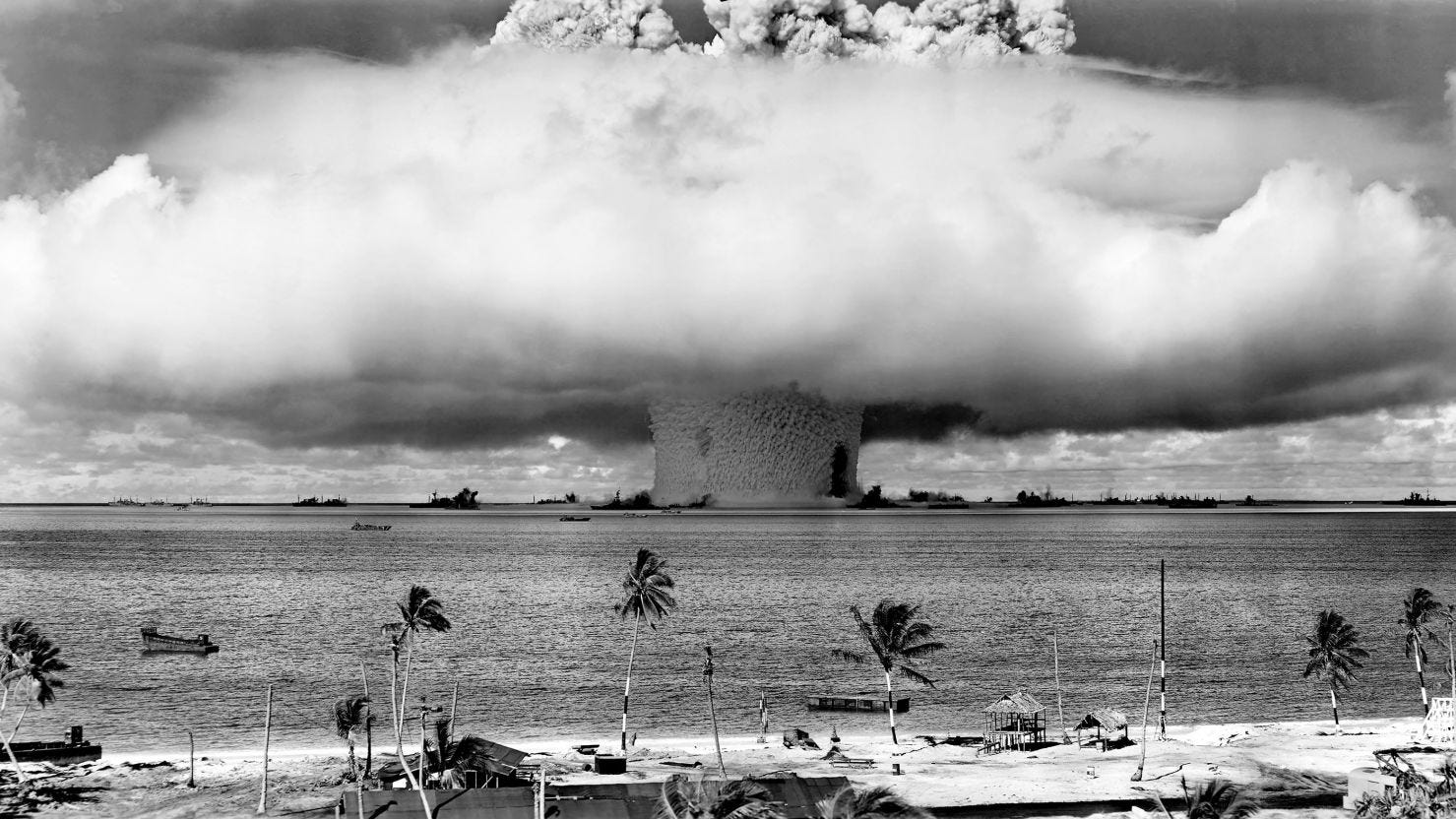
I rarely dedicate an entire briefing to a single topic. Today I am. Last summer I read Annie Jacobsen’s Nuclear War: A Scenario, and it hasn’t left me since. I’ve spent the months since pulling on the thread, reading the science, watching the policy unravel. What I found is that most of us are carrying an incomplete picture of the risk. So today’s briefing is seven pieces, books, films, research, and reporting, designed to give you a clear and accessible understanding of where the nuclear threat stands right now. You can’t fix what you can’t face.
Nuclear War
A single nuclear missile launched toward the United States would trigger a sequence of events measured in minutes, not hours. Annie Jacobsen’s Nuclear War: A Scenario traces that sequence from detection to detonation, drawing on dozens of exclusive interviews with the military and civilian officials who designed the weapons, wrote the response plans, and would have been responsible for executing them. What emerges is a portrait of a system built on razor-thin margins. Decisions that determine the fate of millions must be made in seconds, on intelligence that is only as good as the sensors providing it. Jacobsen doesn’t editorialize or speculate wildly. She simply lays out the choreography, step by step, and lets the machinery speak for itself. Every generation needs a journalist to examine the nuclear establishment with fresh eyes. The question Jacobsen leaves behind is unsettling: not whether the system could fail, but how narrow the margin really is. Amazon (10 hours)
Hasan Minhaj & Annie Jacobsen
Hasan Minhaj sits down with Annie Jacobsen for an 80-minute conversation that is the most accessible entry point into nuclear risk you’ll find anywhere. Jacobsen lays out the mechanics plainly: the President decides alone, in a six-minute window, consulting a strike handbook a former military aide compared to a Denny’s menu. The U.S. maintains 1,770 warheads on hair-trigger alert. If one adversary launches a single missile, 82 go back. If Russia launches, the entire arsenal flies. Minhaj presses on the contradictions most commentators avoid, particularly the double standard of calling foreign arsenals “nuclear blackmail” while keeping 1,700 warheads pointed outward. Jacobsen’s answer keeps returning to the same place: every senior official she interviewed called nuclear weapons insane. The system persists anyway. The conversation is funny, unsettling, and impossible to stop listening to. Hasan Minhaj Doesn’t Know (82 minutes)
A House of Dynamite
Six minutes. That’s how long the President has to decide the fate of civilization after an unidentified ICBM is detected heading for Chicago. Kathryn Bigelow’s A House of Dynamite dramatizes that window with the same procedural intensity she brought to The Hurt Locker and Zero Dark Thirty. Idris Elba leads an ensemble cast playing the officials scattered across the Situation Room, the Pentagon, and Strategic Command, each operating on incomplete information while the clock burns down. Interceptors fail. Advisors split between retaliation and restraint. The Russian foreign minister offers ambiguous denials. And the President, airborne on Marine One, confronts a choice no simulation can truly prepare anyone for. If Jacobsen’s Nuclear War: A Scenario gives you the mechanics, Bigelow gives you the human weight of those mechanics. The film’s title captures the thesis plainly: nuclear deterrence isn’t stability, it’s cohabitation inside an explosive. Netflix (112 minutes)
START Stopped
The last nuclear arms control agreement between the United States and Russia has quietly expired, and almost nobody in Washington seems to care. New START, the treaty that helped reduce global warheads from 70,400 in 1986 to roughly 12,500 today, ended without a successor, a negotiation, or even much of a public conversation. The Bulletin of the Atomic Scientists has moved its Doomsday Clock to 85 seconds to midnight, the closest it has ever been. Meanwhile, pressure is building inside the Pentagon to re-MIRV America’s ICBMs, loading multiple warheads onto missiles that currently carry one. Russia could match that escalation faster. China, which has never signed an arms limitation agreement, is expanding its arsenal at Cold War-era rates. The most unsettling detail isn’t the weaponry. It’s that 91 percent of Americans support maintaining or reducing nuclear limits, yet their leaders are letting the last guardrail disappear in silence. New York Times (8 minutes)
AI and the Nuclear Trigger
Three times during the Cold War, the world came within minutes of nuclear annihilation. Each time, a human being chose restraint over doctrine. The question now is whether an AI system would have done the same. This Brookings analysis revisits the Cuban Missile Crisis, the 1983 Soviet false-alarm incident, and the Able Archer exercise, running each through a chilling thought experiment: what would a machine, trained on the prevailing military logic of the day, have recommended? In every case, the answer is likely escalation. Kennedy’s instincts overruled his entire Joint Chiefs. Stanislav Petrov trusted his gut over his sensors. An Air Force general recognized a dangerous feedback loop before it spiraled. These weren’t algorithmic decisions. They were deeply human ones, shaped by fear, experience, and moral weight. In late 2024, the U.S. and China agreed AI should never control nuclear launch authority. These three stories explain why that agreement matters, and why future leaders cannot afford to walk it back. Brookings (7 minutes)
Hitting a Bullet With a Bullet
Intercepting a nuclear missile is often compared to hitting a bullet with a bullet. The reality is worse: ICBMs travel at seven times the speed of a bullet, and they carry warheads capable of killing a million people each. The Golden Dome initiative promises a next-generation missile defense shield, including potentially thousands of interceptors orbiting Earth, operational before the end of Trump’s term at a cost of $175 billion. A February report from the American Physical Society is skeptical. Protecting against even a single North Korean ICBM would require more than 1,000 space-based interceptors. Defending against 10 simultaneous launches could demand over 30,000, nearly triple the number of active satellites currently in orbit. In space, the physics get even harder: a real warhead and a balloon decoy travel at exactly the same speed, making them nearly impossible to distinguish. Congressional cost estimates for the space-based component alone range from $161 billion to $542 billion over 20 years. The U.S. has already spent more than $400 billion on missile defense over 70 years. The question isn’t whether Americans want protection from nuclear attack. It’s whether the laws of physics will allow it. Science News (8 minutes)
Nuclear Winter
The killing doesn’t stop when the bombs do. A Rutgers-led study published in Nature Food modeled crop production across six nuclear war scenarios, country by country, and found that even the smallest conflict, a limited exchange between India and Pakistan, would cut global caloric production by 7 percent within five years. That alone would exceed the largest agricultural anomaly ever recorded. In a full-scale U.S.-Russia war, the number is 90 percent. More than 75 percent of the planet would be starving within two years. The researchers ran every reasonable mitigation: redirecting livestock feed to humans, reducing food waste. Under large scenarios, the savings were negligible. Mid-latitude breadbasket nations like the U.S. and Russia would see the steepest crop declines, triggering export restrictions that would devastate import-dependent countries in Africa and the Middle East first. The conclusion is blunt: if nuclear weapons exist, they can be used, and any use collapses the global food system. Sixty-six nations have ratified the UN Treaty on the Prohibition of Nuclear Weapons. None of the nine countries that possess them have signed. Nature Food (14 minutes)
Weekend Wisdom
The living will envy the dead. -Nikita Khrushchev on nuclear war